24/7 Emergency Care
+234 802 2837 554
info@afrimedspecialist.com
No 1B William Street, Off Diya Street, Ifako Gbagada, Lagos

Hysteroscopy allows a specialist to look inside the womb to investigate certain symptoms and, in some cases, treat problems found during the examination. Learn how it works and what to expect.

Hysteroscopy is a medical procedure that a gynaecologist use to examine, diagnose and treat conditions affecting the uterus (womb) and cervix. It uses a thin tube with a camera attached to its head known as a hysteroscope which comes in various diameters. The gynaecologist choses the diameter best for the procedure indicated based on pre-assessment.
The hysteroscope is passed through the vagina and cervix into the uterus. Images from the hysteroscope allow the specialist to examine the uterine cavity and look for abnormalities that may require further intervention.
Depending on the reason for the procedure, hysteroscopy may be used for diagnosis, treatment, or both.
Understanding what the procedure involves can help patients have more informed conversations with their healthcare providers and make decisions based on appropriate medical advice.
Hysteroscopy may be recommended when a specialist needs a clearer view of the inside of the uterus as may be indicated from previous tests.
Reasons may include:
These are few indication for hysteroscopy. The gynaecologist will consider the patient’s history, examination findings and other investigations before recommending the procedure.
Hysteroscopy is classified into two broad categories:
Diagnostic hysteroscopy
This is primarily performed to investigate symptoms or examine a suspected abnormality. The findings may help the specialist determine whether further tests or treatments are needed.
Operative hysteroscopy
This involves using special instruments mostly scissors, passed through the hysteroscope to remove certain growth and treat the condition. For example, a specialist may remove a polyp, or remove adhesion that prevent menstral flow or remove fibroid nodules within the uterine cavity.
The exact experience varies according to the patient’s circumstances.
Your specialist will discuss why hysteroscopy is being considered, review relevant medical history and explain the expected process whether the procedure is diagnostic or operative.
It is important you any existing medical conditions, medication and previous history of any other medical procedures including surgeries.
The healthcare team will also explain available pain-relief options including anesthesia and other preparation instructions.
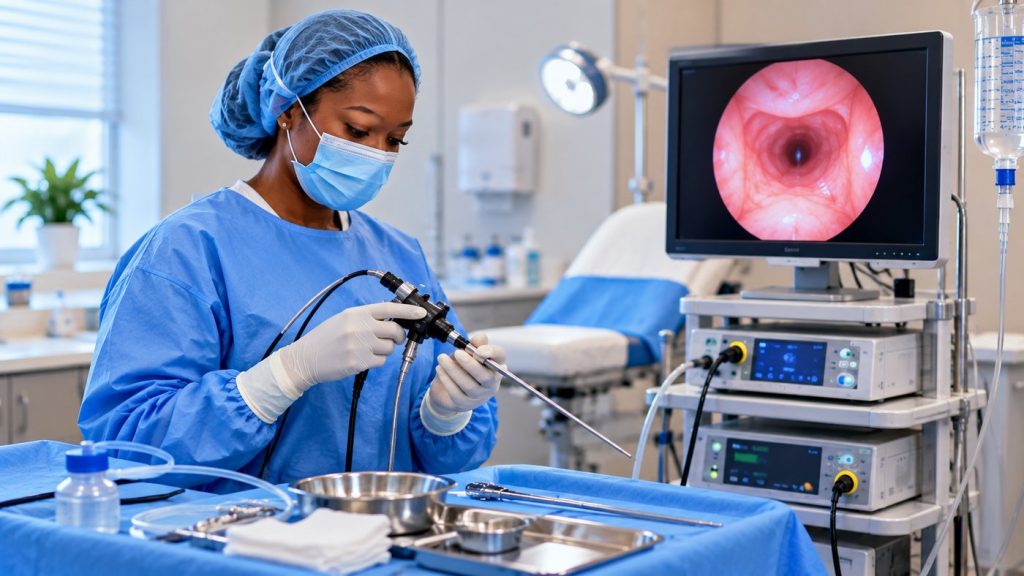
Hysteroscopy provides a direct view of the inside of the uterus without an abdominal incision.
The procedure is done either in an endoscopy room or a theatre room. After all pre examination counselling and preparation, consent is taken and the patient is positioned (lithotomy) appropriately in for the examination.
The narrow tube with the lighted camera head passes through the vagina and cervix into the uterus. A fluid, commonly sterile saline, is introduced and regulated by a pump system to help the specialist see the uterine cavity more clearly. The fluid is not retained. it flows through to expand the view and drains out through the pump system.
The images are displayed on a coloured monitor, allowing the specialist to examine the inside of the uterus.
If the procedure is to be operative, treat a condition, special instruments, usually special flexible scissors will introduced when appropriate to cut and remove tissue or fibroid nodules.
On completion of the procedure, the specialist will explain the findings and discuss necessary treatment or follow-up required.
If a tissue sample has been collected, this is sent to laboratory for histology and result of this test may also determine the next level of intervention.
Just like most medical procedure, hysteroscopy is usually uncomfortable, while some experience pain similar to strong menstrual cramps, others main experience more significant pain.
The level of pain also depend on the procedure, whether it is diagnostic or operative.
Pain management options may include medication, local anaesthesia, sedation or general anaesthesia, depending on the clinical situation and individual specification. This is usually discussed prior to the procedure.
It is important to discuss pain and pain management options that are appropriate for you during and after the procedure.
Hysteroscopy is commonly performed and considered relatively safe but, like other medical procedures, it has potential risks.
Possible complications include infection, bleeding, injury to the cervix or womb, and problems associated with the fluid used during the procedure. The likelihood of complications depends on some factors such as the complexity of the procedure and the patient’s health.
Your specialist should be skillful and experienced on the procedure and must be detailed in explaining the benefits and the relevant complications before you give consent.
Follow the specific aftercare instructions provided by your healthcare team and seeking medical attention if you develop symptoms such as heavy bleeding, severe or worsening abdominal pain, fever or unusual, unpleasant-smelling vaginal discharge after the procedure.
Recovery varies depending on whether the procedure was diagnostic or operative and whether anaesthesia or sedation was used.
Many often return to ordinary activities relatively soon, but the timing depends on their individual circumstances and the procedure performed.
Your specialist will explain your peculiarity if any and recommend when you can return to work, active exercise and other usual activities to include sexual activity, tampons and any restrictions that apply to your recovery.
It is important that the instructions provided by your specialist is adhere to strictly rather than assumption.
Consider keeping this list to guide your enquiry when going to your specialist:
These questions can help you understand your options and participate more confidently in decisions about your care.
When further investigation is needed, understanding the purpose of a recommended procedure is an important part of the care journey.
At Afrimed Specialist Hospital, you have the privilege to meet and consult with our team lead, Dr. A.O Soyemi who gives you the opportunity to explain your symptoms, ask questions and understand whether hysteroscopy may be suitable for you. Dr. Soyemi is a graduate of London University’s Kings College and St George’s Hospital medical school. He is a fellow of Royal college of Obs & Gyn (RCOG) of the UK as well as Fellow of West African College of Surgeons (WACS) and West African College of Obs & Gyn (WACOG). An experienced Obs&Gyn of almost 50years of practice in the specialty with the largest part in the UK. He was a full time substantive gynaecologist and lead clinician for gynaecological cancer across the two acute hospital sites for East Sussex Healthcare NHS Trust in the UK. He was also a part-time teacher and consultant at the Brighton & Sussex University Hospitals. He retired home to give back to his country. He is a well known expert in gynaecological endoscopy (keyhole) surgeries.
A closer look. Specialist care.
To enquire about hysteroscopy or appointment availability, contact Afrimed Specialist Hospital through its official communication channels. Call or WhatsAPP +234 8022837554 OR Email info@afrimedspecialist.com. You can also visit our website to complete your appointment booking; www.afrimedspecialist.com